
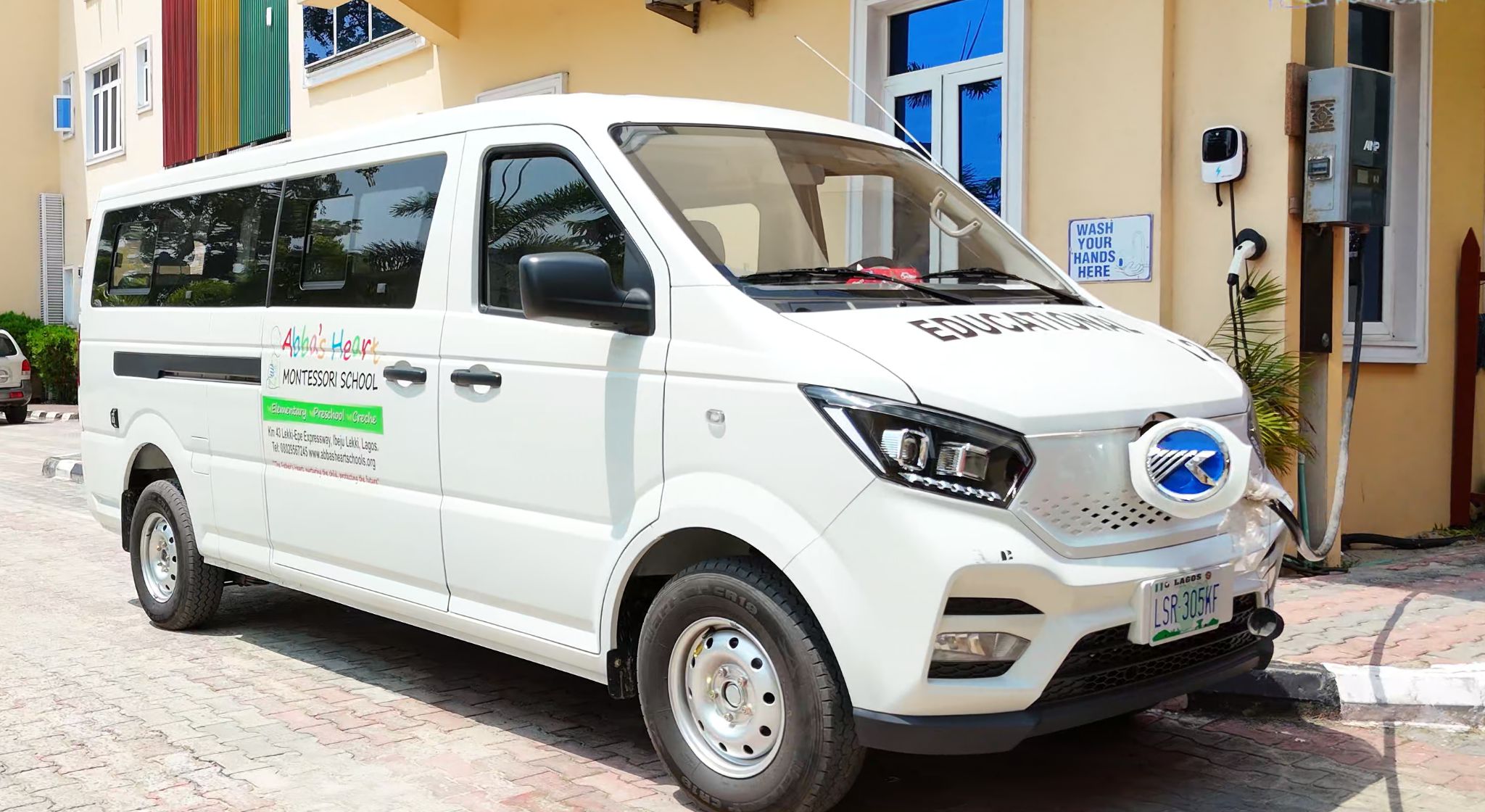
Driving the Future Quietly: The Electric Bus Story at Abba’s Heart Montessori School
Every morning at Abba’s Heart Montessori School, something powerful happens long before the first lesson begins.
Parents pull up to the gate and hand over what matters most to them — their children. There is trust in that exchange. Trust in the teachers. Trust in the system. And importantly, trust in how those children arrive and how they return home.
Six months ago, that daily routine began to sound very different.
Or rather, much quieter.
Abba’s Heart Montessori School made a bold and historic decision to fully implement electric buses across its transport system, becoming the first school in Nigeria to run a complete electric fleet of school buses. In a country where conversations around electric vehicles in Nigeria and sustainable transport are still developing, the school took a decisive step toward the future of e-mobility.
It wasn’t a decision driven by trend or spectacle. It was rooted in something deeper — responsibility.
The leadership of the school began asking thoughtful questions about the kind of future they were preparing their students for. If the classroom encourages innovation, environmental awareness, and forward thinking, shouldn’t the school’s operations reflect those same values? Transportation, after all, is one of the most visible extensions of a school’s culture.
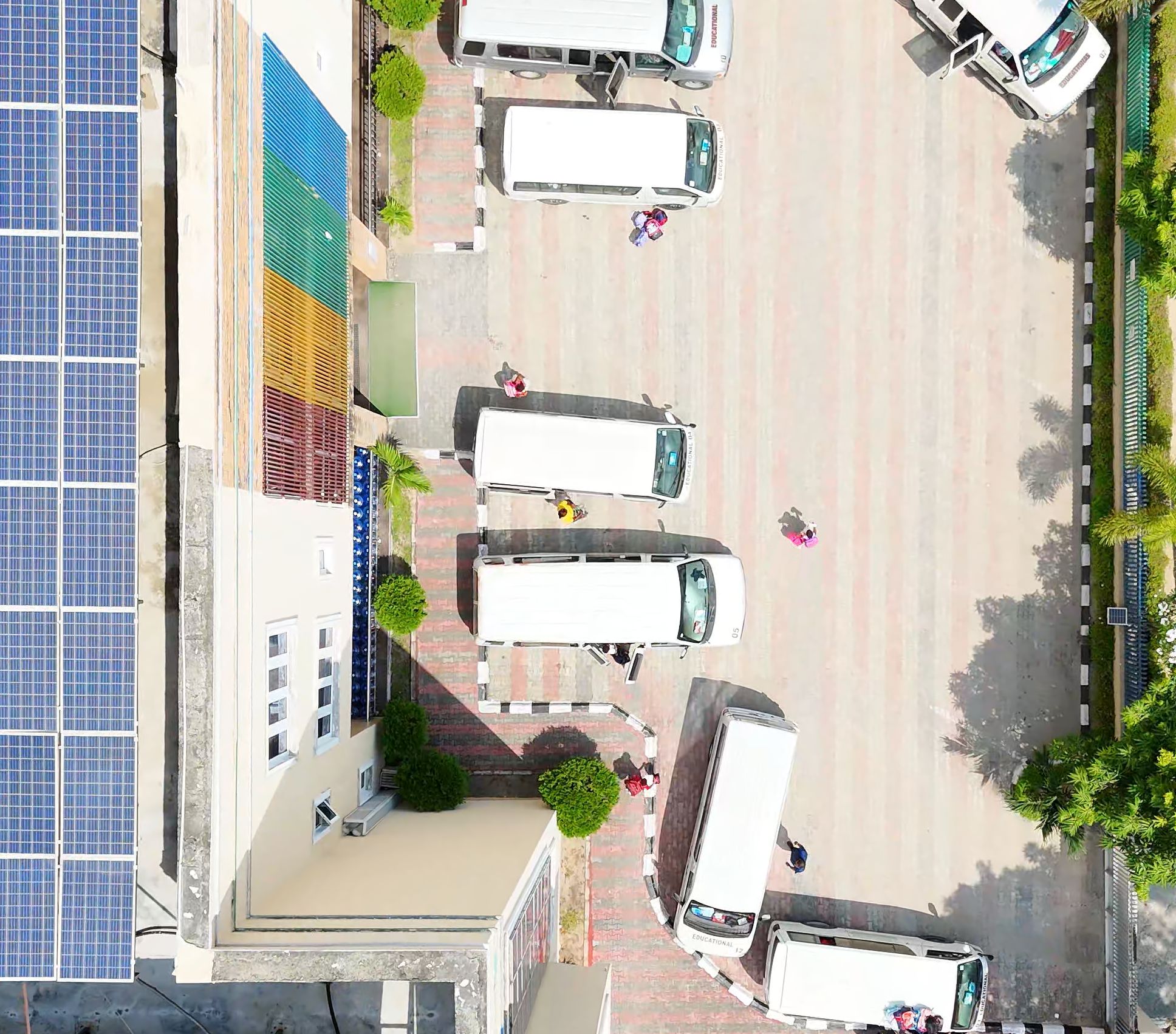
That question opened the door to fleet electrification.
The journey began with careful consultation alongside EV World Africa, whose advisory team worked closely with the school to understand its routes, daily mileage, operational flow, and long-term vision. This wasn’t about swapping diesel for batteries overnight. It was about clarity — ensuring that the transition to electric vehicles would be sustainable, reliable, and practical within the realities of electric mobility in Lagos.
After thoughtful evaluation, the e-buses were acquired through Electric Mobility Centre. But the school understood something important: e-mobility is not just about vehicles. It is about the ecosystem that supports them.
A strong charging infrastructure was essential.
To support daily operations, EV charging infrastructure was deployed by AMP Charging Station. Dedicated charging stations were installed to ensure the buses could charge efficiently between routes and remain ready for the next school day. Reliable EV charging meant drivers no longer needed to think about fuel stops; instead, the buses followed a predictable charging routine that fit naturally into the school’s schedule.
Energy was another key piece of the puzzle.
To reinforce its sustainability goals, the school integrated solar energy into its power strategy through Renewable Lifestyle Engineering. With support from solar systems and an off-grid energy approach, the charging ecosystem is partially supported by renewable power. The concept goes beyond simply running electric vehicles — it reflects the broader potential of solar farms and distributed solar energy to support EV charging infrastructure across Nigeria.
The pieces connected.
The electric vehicles, the charging stations, the solar-powered energy source, and the broader operational planning aligned to form a working electric mobility ecosystem inside a school environment.
Then came the first day the buses rolled into the school compound.
Students gathered around with wide-eyed curiosity. Parents watched closely. Drivers adjusted to a new experience behind the wheel.
And then there was the silence.
No heavy ignition. No rumbling engine. No exhaust fumes in the morning air. Just smooth movement as the electric buses in Lagos quietly glided forward.
What might seem like a small difference quickly revealed itself to be meaningful.
Inside the bus, conversations became clearer. The ride felt calmer. The environment felt intentional. For many students, this was their first direct encounter with an electric vehicle, turning their daily commute into a living example of innovation.
Over the past six months of consistent operation, the electric bus fleet has become part of daily life at Abba’s Heart.
Drivers speak about the smooth acceleration and the simplicity of driving electric vehicles. Administrators talk about the reliability that comes with structured EV charging rather than unpredictable fuel logistics. Parents see something tangible — proof that the school is preparing students for a world increasingly shaped by clean energy, solar power, and electric mobility.
What makes this story remarkable is not simply that electric buses were introduced.
It is that they were fully implemented, supported by charging infrastructure, strengthened with solar energy, and sustained through thoughtful planning.
They committed to the vehicles.
They committed to the charging stations.
They committed to the energy system.
And in doing so, they quietly demonstrated what fleet electrification in Nigeria can look like when vision meets execution.
In a country where the transition to electric vehicles in Nigeria is still in its early stages, one school chose to lead by example. Not loudly. Not dramatically. But consistently.
Three electric buses now move through Lagos roads carrying students who represent the next generation. They move without fumes. They move without noise. They move with purpose.
And perhaps that is the most powerful lesson of all.
Abba’s Heart Montessori School is not just teaching children about the future of electric mobility and sustainable transportation.
It is showing them what it looks like to build it.